Showing posts with label silica. Show all posts

Sunday, December 20, 2015

NASA Curiosity Finds out the Starcraft Protoss Silica leftovers on Mars - http://clapway.com/2015/12/20/nasa-curiosity-finds-out-the-starcraft-protoss-silica-leftovers-on-mars/

The NASA Curiosity rover has come back with some awesome findings. This rover has found very high concentrations of silica on Mars. Also, speaking of this mineral, anyone ever notice that it looks very familiar to the Starcraft Protoss race?


Minerals Clapway


WHAT SILICA IS


Silica is a mineral that is very abundant. As a matter of fact, the chances of you using it every day are very good. It is the most abundant mineral in the earth’s core. It is the main component of most sands and is also the primary mineral in glass. This is also another name for silicon dioxide. This mineral has also been around for a very long time. Under normal conditions, this is a solid and it has a crystallization outside.


NASA CURIOSITY FINDS SILICA ON MARS


NASA announced this news of silica found on Mars just recently. They said that the rover discovered tridymite, which is a very rare mineral. The company said that the NASA Curiosity used its laser named ChemCam to detect the silica. NASA also stated that this mineral was found on the higher hydrogen level areas of Mars. A member of NASA actually stated that they themselves do not fully understand the high silica levels. He mentions how they are a puzzle.


STARCRAFT PROTOSS RACE LOOKS LIKE SILICA


Going completely off topic for a minute, did anyone else notice how eerily similar silica is to the Starcraft Protoss race. The Protoss are a race in the science fiction real-time strategy video game Starcraft. Their overall presence honestly makes it look like this race was made completely out of the element. They are an alien species and, in the world of Starcraft, once considered themselves the most dominant species in the galaxy. If you do not believe me, put up a picture of this race and the mineral and compare them.


STARCRAFT PROTOSS RACE LOOKS LIKE SILICA Clapway


NASA CURIOSITY RELEASES VIDEO AND IMAGES


If anybody is curious about what this looked like, NASA has released images from the site on this discovery. Not only that but a video can also be watched about this discovery. While this is not the actual ordeal, it offers a re-enaction of what the rover was doing on Mars. This video is also included with all of the sound effects that were present.


NASA Curiosity Finds out the Starcraft Protoss Silica leftovers on Mars

Wednesday, October 28, 2015

Saturn"s Moon Enceladus Has Primordial Core - http://clapway.com/2015/10/28/saturns-moon-enceladus-has-primordial-core123/

NASA’s Cassini spacecraft will zoom close to Saturn’s moon Enceladus in an attempt to fly through a plume of icy spray thrown up from the alien world’s surface. This flyby will shed light on new research published this week suggesting that Enceladus, sixth largest of many moons that orbit the famous ringed planet, has a core that is similar to primitive meteorites found on Earth.


Saturn
Saturn’s moon Enceladus with plumes spraying from fractures in the south polar region. Courtesy of NASA.

CHEMISTRY BENEATH THE SURFACE


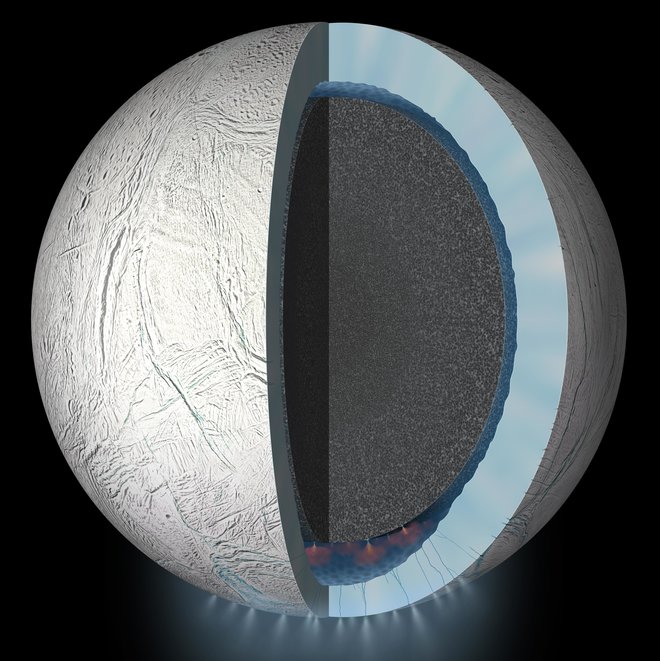
Analysis of the chemical composition of the geyser-like plumes that erupt from the moon suggests that chemical reactions are taking place between water and rock deep beneath the surface, according to the research which appears this week in the academic journal Nature Communications.


These plumes have been studied for some time by the Cassini space probe which has been in orbit around Saturn since 2004. They have been found to consist of ice and tiny silica-rich particles that are thought to originate from deep within the moon. Experiments conducted back on Earth by the scientists who have written the new paper indicate that the make up of the rocks that give rise to these silica particles must be very similar to the primordial mixture of minerals thought to date from the very earliest days of the solar system.


This discovery means that the formation of Enceladus and Saturn date back to within just four million years of the formation of the entire solar system around 4.6 billon years ago, the researchers state – a mere blink of an eye in astronomical terms.


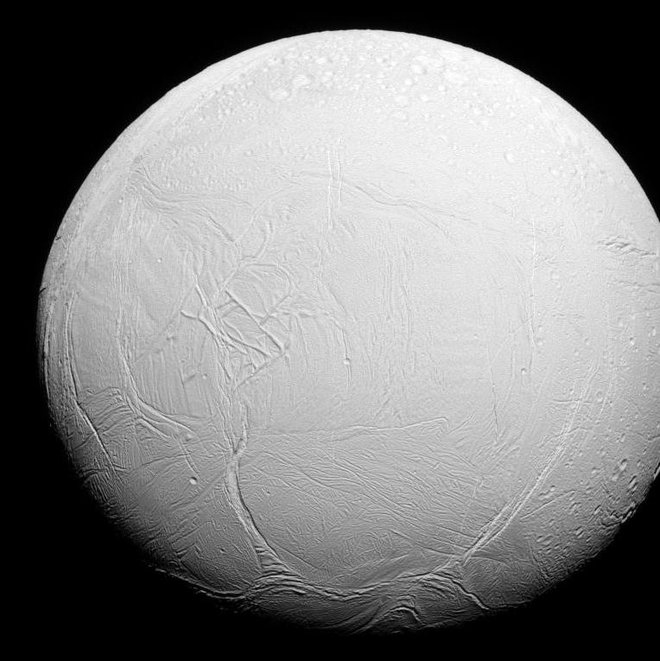
Enceladus. Courtesy: NASA/JPL
Courtesy of NASA

Ice Cold Ocean Sits On Warm Rocky Bed


This research suggests that the south pole of Enceladus, where the plumes are seen, consists of a shell of ice perhaps 19 miles (30km) thick which floats on top of an ice-cold ocean of water that is maybe 6 miles (10km) deep that itself sits on a bed of warm, porous, rock. Reactions between the warm rock and water determine the chemical salts that are dissolved in the ocean and hence the composition of the geysers which erupt through the moon’s icy surface.


The researchers are unsure whether the whole core of Enceladus is warm due to residual heat left over from the formation of the moon or whether it is just the upper layers of the core that are warm due to geological activity or even a meteor impact. The porous nature of the core means that it would probably lose heat rapidly and this suggests that a recent ‘incidental heating’ event may be responsible, they report.


Cassini Flyby Of Enceladus


The Cassini probe’s ‘deep dive’ Enceladus flyby will gather more data on the plumes which may help to corroborate the findings reported by this research. The spacecraft will make its closest approach to Enceladus at 15.22 GMT/11.22 EDT on Wednesday at an altitude of 30 miles (49 km) above the moon’s south polar region.


Take SHOWME Laser Keyboard on your Trip to Saturn


https://www.youtube.com/watch?v=m5cxM-g_b9w


Saturn"s Moon Enceladus Has Primordial Core