Showing posts with label churyumov-gerasimenko. Show all posts

Wednesday, October 28, 2015

Rosetta Finds Molecular Oxygen On A Comet - http://clapway.com/2015/10/28/rosetta-finds-molecular-oxygen-on-a-comet123/

Molecular oxygen has been found in the cloud of gas around a comet in apparent contradiction with theories of how our solar system was formed. The detection of molecular oxygen on a comet is ‘the most surprising discovery so far’ made by the European Space Agency’s Rosetta spacecraft, according to scientists.
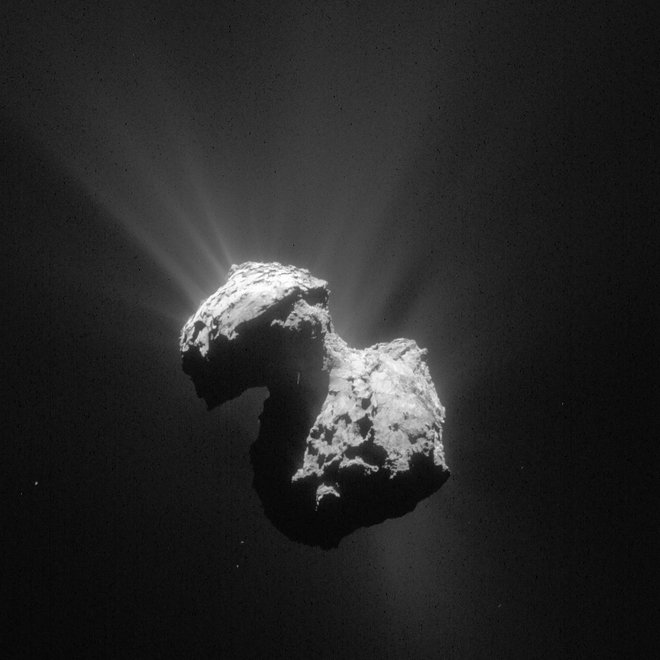

This single frame Rosetta navigation camera image of Comet 67P/Churyumov-Gerasimenko was taken on 7 July 2015 from a distance of 154 km from the comet centre. The image has a resolution of 13.1 m/pixel and measures 13.4 km across. Courtesy: ESA/Rosetta/NAVCAM
Comet 67P/Churyumov-Gerasimenko in an image captured by Rosetta. Courtesy: ESA/Rosetta/NAVCAM

This Does Not Fit With Current Theories


Rosetta has been in orbit around comet 67P/Churyumov-Gerasimenko since August 2014. It detected the presence of molecular oxygen in the cloud surrounding the comet’s nucleus, known as the coma, using an on board mass spectrometer which can analyze the composition of gases.


‘Oxygen is not among the molecules we expected to see in a cometary coma,’ said Professor Kathrin Altwegg, from the University of Bern in Switzerland, one of the scientists involved in the discovery. Dr Andre Bieler of the University of Michigan, another scientist working on this research, said ‘it will need a significant amount of work’ to make this finding fit in with models of how the solar system evolved. The discovery is reported by Altwegg, Bieler and colleagues in the scientific journal Nature today (Wednesday 28 October 2015).


Chemical compounds - Clapway


Oxygen Should Be Bound Up In Chemical Compounds


Oxygen (O2) is a highly reactive gas which means that it should be locked up in chemical compounds such as water. Rosetta has found that the molecular oxygen present in the cometary gas cloud amounts to between one per cent and 10 per cent of the amount of water vapour present in the cloud – this is a lot – and the ratio seems to remain constant.


The fact that molecular oxygen has been found in such significant quantities and that the ratio of oxygen in the coma does not change over time suggests that it is being released from within the nucleus of the comet as it warms up. The implication is that these oxygen molecules have been stored in the core of the comet since the comet was first created rather than continuously created by the break down of water or other oxygen containing compounds as the comet approaches the sun. The scientists write in their Nature paper that ‘the preferred explanation of our observations is the incorporation of primordial O2 into the cometary nucleus’.


A Very Common Comet – A Very Big Mystery


‘If this is the only comet with molecular oxygen then it is a special case but I do not think so,’ said Altwegg. ‘This is probably a very common comet’.


The trouble is that theories of solar system formation are not consistent with the presence of so much molecular oxygen in the primordial mix that made our sun, the planets and the comets.  Furthermore, molecular oxygen has so far been detected in only two interstellar gas clouds, according to researchers, although the abundance in one is comparable with that found in the comet.


This is what happens with Rwatch R10 if it hits the ground


https://www.youtube.com/watch?v=QCsj_JIRVAM


Rosetta Finds Molecular Oxygen On A Comet

Monday, August 3, 2015

67P Makes Its Closest Pass By the Sun With Rosetta in Tow - http://clapway.com/2015/08/03/67p-makes-its-closest-pass-by-the-sun-with-rosetta-in-tow-355/

On August 13 the 67P/Churyumov-Gerasimenko comet will be making its closest approach to the sun in its 6.5 year orbit — and it will have Rosetta in tow. This will be the first time a comet has entered perihelion with a human spacecraft present to observe the event.


67P’s Journey Around the Sun


The comet, which was recently reported to contain the building blocks of life, makes its way around the sun every 6.5 years. Philae, the lander from the Rosetta spacecraft, met up with 67P about 336 million miles from the center of the solar system, after traveling a whopping 75,000 miles per hour to reach it. Now the two are set to arrive at perihelion, a point in a comet’s orbit where it’s closest to the sun, on August 13.


According to the European Space Agency (ESA), this is a very important moment in every comet’s life. In fact, some comets don’t make it past the event and are destroyed. For Philae and 67P, this is an especially important event since it will be the first time a comet has entered perihelion with a lander in tow.


What Happens in Perihelion


For 67P/Churyumov-Gerasimenko, life closer to the sun is certainly more active. Since Philae landed on the comet, things have warmed up due to an increase in exposure to solar energy. This is causing some of the ice on the comet to evaporate, creating a hazy atmosphere around 67P.


Some comets end up orbiting too close to the Sun and end up being destroyed by it; these types of comets are called ‘sungrazers’. 67P/Churyumov-Gerasimenko will actually be further away from the sun than Earth is, so it’s in no danger of biting the bullet.


Rosetta Will Be Operating From a Safe Distance During Perihelion


The last time 67P completed its perihelion was on February 28, 2009. On that date, and prior orbits, the comet experienced the event relatively trouble free. This year’s event is expected to also proceed smoothly with Rosetta following the comet at a safe enough distance to ensure nothing problematic occurs as the pair head back out into the outer reaches of the solar system. After, Rosetta will continue to study 67P/Churyumov-Gerasimenko as it hurtles its way around the sun.


Grab some space adventures for the young with Space Scouts:


67P Makes Its Closest Pass By the Sun With Rosetta in Tow